
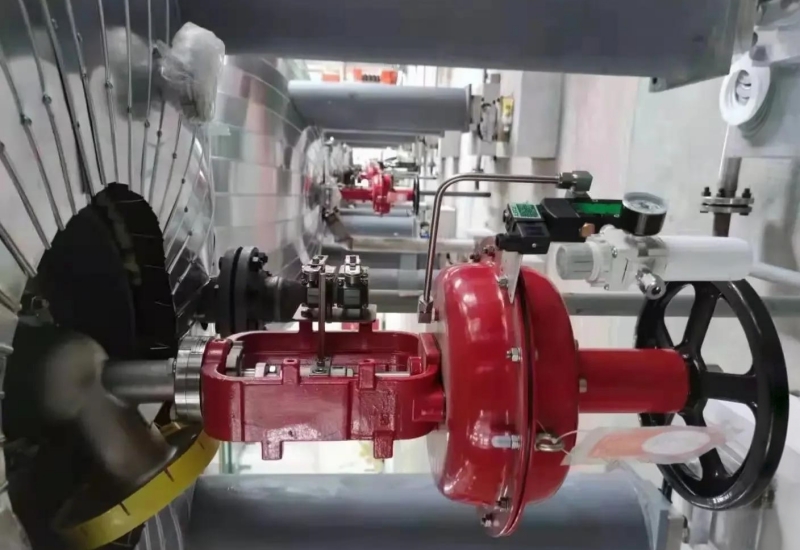
In a petrochemical reactor the chemistry sets its own rules about temperature, and the control system exists to keep the process inside them. Exothermic reactions release heat that must be removed as fast as it appears, or the temperature climbs, the reaction accelerates and the situation turns into a runaway. Endothermic reactions need a steady supply of heat, and many batches move between heating and cooling in a single cycle. On top of that the reactor pressure has to stay inside the design window of the vessel. This article looks at the control valves that carry the heat in and out, and at the pressure paths that keep the vessel safe.
What Reactor Control Has to Handle
Two things make reactor temperature control harder than most loops. The first is that the heat load changes with the reaction itself. A polymerization or oxidation step can move from mild to violently exothermic in minutes, and the cooling system has to follow. The second is that the heat must cross a wall. The reaction happens inside the vessel, while the heating and cooling media run outside it, in a jacket, in internal coils or in an external heat exchanger loop, and every degree of temperature difference across that wall has to be paid for in heat transfer area and response time.
Pressure adds a separate dimension. Gases are fed, vapours are evolved and in some processes the pressure is part of the reaction driving force. The vessel and its relief system define the limits, and the control valves have to keep the normal operating band inside those limits while responding fast enough to prevent excursions.
Temperature Control Strategies
Most reactors control temperature by controlling the heat transfer medium, and three arrangements dominate. In jacketed vessels, the medium in the jacket is heated or cooled, and the reactor temperature follows. The classic refinement is cascade control, where the reactor temperature is the master and the jacket temperature is the slave, so a disturbance in the jacket is corrected before it reaches the reactor. Internal coils give more area for a given vessel but complicate cleaning and can foul. External circulation loops pump the reactor contents through an outside heat exchanger, which suits large vessels and reactions where internal surfaces are a problem.
| Arrangement | How It Works | Where It Fits |
|---|---|---|
| Jacket with split-range valves | One valve trims hot medium, the other trims cold medium, sharing one controller signal | Batch reactors that heat and cool in one cycle |
| External circulation loop | Pump circulates reactor contents through an outside exchanger with bypass control | Large vessels, fouling services, existing heat recovery |
| Direct injection | Steam or cooling water added straight to the contents or the vapour space | Fast heating, quench cooling, specific process steps |
For a batch that must both heat up and cool down, split-range control is the standard answer. One controller output drives two valves in opposite directions, the hot medium valve closing as the cold medium valve opens. The overlap between them is tuned carefully, because too much overlap wastes energy and too little leaves a dead band where neither valve moves.
Control Valves in the Heat Transfer Loop
The valves in this loop see a different duty from ordinary process control. They cycle constantly, since a reactor holds temperature by opening and closing the medium valves in small corrections, and they switch between full hot and full cold service. For the jacket medium itself, a two-port control valve on the supply line is the common choice, with the flow characteristic matched to the heat transfer behaviour of the jacket. Equal percentage is a frequent starting point because the heat transferred is not linear with medium flow.
Speed of response matters here more than in most services. A slow valve turns a recoverable temperature upset into a long deviation, and in exothermic service it can be the difference between a controlled excursion and a runaway. Pneumatic actuators with positioners are the usual answer, since they combine speed with the fail-safe spring action that electric actuators need extra hardware to provide. Fail-safe position is a safety decision, not a preference: a cooling failure in an exothermic reactor often calls for the cooling valve to fail open and the heating valve to fail closed, so the last action of the plant is to cool.
Pressure Control and Protection
Reactor pressure control has two faces. During normal operation a pressure control valve on the vapour line holds the vessel at its operating pressure, venting to a flare or recovery system as gas is evolved or fed. Around that loop sit the protective devices: a relief valve sized for the worst credible case, which for an exothermic reactor includes the cooling failure scenario, and the interlocks that close feed valves or open quench paths when temperature or pressure leaves its band.
The pressure control valve itself needs to handle whatever the vapour space produces, clean gas in most processes but occasionally entrained liquid, polymer mist or corrosive by-products. Its failure position follows the process: a vent valve that fails open protects the vessel, while a valve that must hold pressure for the reaction usually fails closed and relies on the relief system instead.
Valve Selection Notes
Materials for reactor valves follow the process stream they touch. Jacket medium valves handle water, steam or thermal oil and can be standard carbon steel. Valves on the reactor contents face the chemistry, so corrosion resistance, cleanability and temperature rating come from the process specification, with stainless steel, alloy or lined bodies where the duty demands them. Trim erosion is a real factor in slurry and polymer service, and hardened trim or special seats earn their cost there.
Leakage class and packing follow the same logic as the rest of the plant. Tight shutoff matters when a valve isolates a hot or cold medium, because a leaking jacket valve fights the temperature loop all day. Low-emission packing is worth specifying where the reactor contents are volatile or hazardous. In classified areas the actuators and positioners carry the appropriate explosion-proof rating, and the actuator choice between pneumatic, electric and self-operated is covered in more detail in the actuator selection guide.
Operating Realities
Several practical points decide whether a well-designed reactor loop actually works. Dead time is the biggest one. The temperature measurement sits inside the vessel while the valve acts on the jacket, so the loop is slow and the tuning has to respect that, which is exactly why cascade control helps. Valve wear shows up first as a drifting temperature, not as a leak, because a worn jacket valve responds unevenly at small openings. And fouling changes the heat transfer coefficient over time, so a loop that was tuned at start-up drifts as the season passes, and periodic retuning is part of reactor maintenance.
Stiction and hysteresis in the valves deserve attention in the same way. A reactor temperature loop cycles in tiny corrections, and if the valve sticks and jumps, the controller sees a persistent error and the jacket temperature swings. A positioner with good repeatability, and valves with low-friction packing, do more for reactor temperature stability than most tuning changes ever will.
Conclusion
Reactor temperature and pressure control is a heat transfer problem before it is a control problem. The heat of reaction has to cross a wall through a jacket, a coil or an external exchanger, and the control valves on the medium side carry the whole burden of keeping the reactor inside its window. Split-range valve pairs handle the heating and cooling halves of a batch cycle, fast pneumatic actuators with the right fail-safe position cover the safety side, and the pressure path keeps normal operation clear of the relief devices. Sized and selected for the medium they actually carry, and tuned with the dead time of the vessel in mind, these valves give the reactor the one thing it cannot improvise, a heat removal path that never falls behind the reaction.
 No products in the cart.