
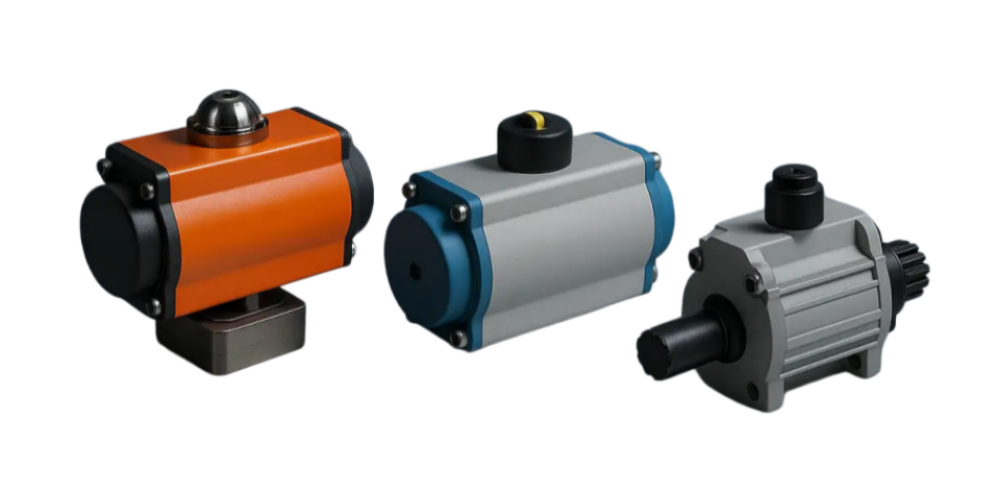
The actuator is the part of a control valve that moves the plug. It converts the control signal into stem travel, and its behavior sets the response speed, precision and reliability of the loop. Three types dominate: pneumatic, electric and self-operated. The right one depends on the energy available on site, the response and accuracy you need, fail-safe requirements and the environment.
Pneumatic Actuators
Pneumatic actuators come in diaphragm and piston forms. They respond fast, produce high thrust, and contain no electrical components, so there is no spark risk and they are a natural fit for hazardous areas. They need a clean instrument air supply, typically 140-400 kPa. Air-to-open and air-to-close action is standard, and a spring return gives a simple fail-safe (fail open or fail closed). With a smart positioner, control accuracy reaches ±0.5-1 %. Multi-spring designs such as the ZHA/B series pack a large output force into a compact unit.
Electric Actuators
Electric actuators drive the plug with a servo motor, reduction gear and screw. They are the choice when instrument air is unavailable and precision automation is the point. Power comes from 220 V AC, and standard signals (4-20 mA / 0-10 V DC) drive them directly; smart versions talk HART, Foundation Fieldbus or Profibus. Types with a built-in servo amplifier, such as PSL, 361L and 381L, position the valve directly and precisely. The trade-off is speed: a full stroke takes from a few seconds to tens of seconds. In hazardous areas they need an explosion-proof (Ex d) enclosure, and fail-safe on power loss requires a spring or battery backup; otherwise the valve holds its last position.
Self-Operated
Self-operated valves use no external energy at all. The pressure or temperature of the process medium itself positions the valve, so the construction is simple, the cost is low and there is almost nothing to maintain. Accuracy is lower, in the ±2-10 % range, and each valve controls a single parameter, pressure or temperature. Typical duties are pressure reduction, relief, back pressure and temperature regulation, for example the ZZYP, YZW and ZZYVP series.
Comparison Table
| Dimension | Pneumatic | Electric | Self-Operated |
|---|---|---|---|
| Energy | Instrument air required | 220 V AC power required | None (uses the medium’s energy) |
| Response | Fast (seconds) | Moderate (seconds to tens of seconds) | Slow (natural response) |
| Control accuracy | ±0.5-1 % with smart positioner | ±0.5-1 % typical | ±2-10 % |
| Fail-safe | Spring return standard (fail open/close) | Holds position; backup needed | Inherently safe |
| Installation cost | Actuator + air supply system | Actuator + power wiring | Valve only |
| Maintenance | Positioner calibration, air filter servicing | Periodic checks | Almost none |
How to Choose
The decision usually falls out of the site conditions:
- Instrument air available: pneumatic. Fast, safe in hazardous areas, easy fail-safe.
- Power only, precision and automation wanted: electric with a built-in servo amplifier.
- No energy at all, remote or unattended site: self-operated.
- Hazardous (explosive) area: pneumatic (intrinsically safe) or an Ex-rated electric actuator.
- Fail-safe on air or power loss is mandatory: pneumatic with spring return (fail open/fail closed).
- High control precision is critical: electric, or pneumatic with a smart positioner.
NW VALVE Product Reference
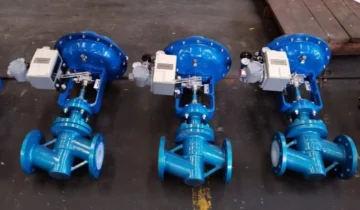
NW VALVE builds all three families, so the type can be matched to the duty rather than forced: electric control valves with PSL/361L/381L actuators (ZDLP, ZDLM), pneumatic control valves with ZHA/B multi-spring diaphragm actuators (ZJHP, ZJHN), and self-operated regulators for pressure and temperature (ZZYP, YZW, ZZYVP).
Conclusion
Match the actuator to the energy available, the response and accuracy required, fail-safe behavior and the environment. Pneumatic with spring return is the most versatile default; self-operated gives energy-free reliability; electric gives precision and automation. Getting this right matters as much as sizing the valve body.
 No products in the cart.