
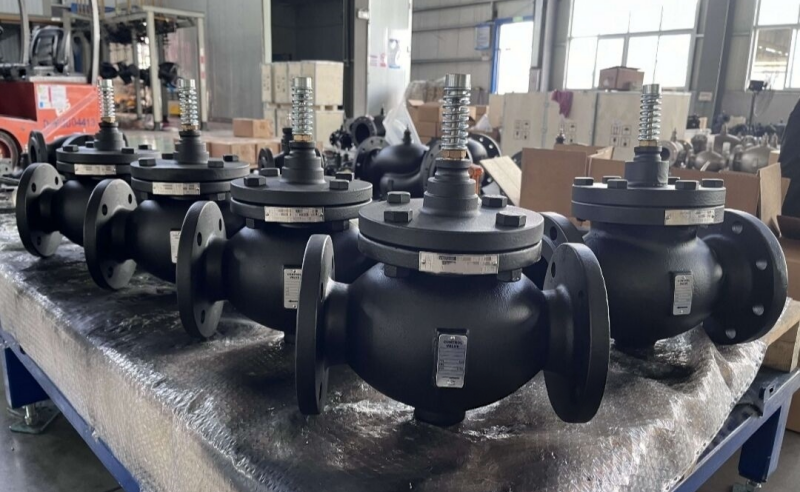
In the chemical, petroleum, pharmaceutical, food processing and HVAC industries, temperature control is a critical link that ensures production safety, improves energy efficiency and guarantees product quality. The self-operated temperature control valve, an energy-saving valve that requires no external power and regulates automatically using the medium’s own energy, is increasingly favored by process plants. This article provides a complete selection reference for self-operated temperature control valves, covering the working principle, key selection points and typical application scenarios, to help you make an informed decision.
Working Principle
A self-operated temperature control valve (also known as a self-acting temperature control valve) consists mainly of a control valve body and a temperature controller (sensor). Using the principle of liquid thermal expansion or vapor pressure change, it automatically adjusts the valve opening according to the temperature of the controlled medium, without requiring an external power or air supply, achieving constant temperature control.
By function, self-operated temperature control valves fall into two main categories:
- Heating type: the valve closes as the medium temperature rises; used in steam or hot water heating systems.
- Cooling type: the valve opens as the medium temperature rises; used in cooling water or refrigerant systems.
In addition, three-way converging and diverging types are available for mixing or splitting temperature control.
The outstanding advantages of the self-operated temperature control valve include simple construction, low maintenance, reliable response and explosion-proof safety, making it especially suitable for harsh environments or locations without a power supply.
Key Selection Points
Correct selection directly affects system stability and service life. The following key parameters should be considered:
- Media characteristics: identify the media type (steam, hot water, heat transfer oil, gas, etc.), corrosivity, viscosity and cleanliness. For non-corrosive media, a standard type is preferred; for corrosive media, a body in special materials (such as stainless steel or special alloys) is required.
- Working temperature range: confirm the set temperature point and the maximum/minimum working temperatures. Heating types usually cover a wide control range, and the sensor capillary length and filling medium must be matched to the application.
- Pressure parameters: nominal pressure (PN) and differential pressure range. A higher pressure class keeps the valve working stably under system fluctuations.
- Flow and valve size: calculate the required Cv value from the system flow (m³/h or kg/h) and the pipe size (DN15-DN300 is common). Avoid over-sizing or under-sizing, which causes poor regulation accuracy or excessive pressure loss.
- Control accuracy and type: proportional regulation is the main mode, and some high-end valves support high-accuracy requirements. Choose the appropriate construction: heating/cooling type, three-way type, and so on.
- Installation environment: consider the ambient temperature, explosion-proof requirements and capillary length (sensor installation position). Sealing and durability are decisive for the service life of the valve.
- Other factors: brand reliability, after-sales service and certifications (such as ISO and CE).
Typical Application Scenarios
- Heat exchanger temperature control.
- Boiler auxiliary heating systems.
- Constant temperature control in petrochemical reactors.
- Sterilization and fermentation processes in food and beverage production.
- Central air conditioning and heating networks.
In these scenarios, the self-operated temperature control valve significantly reduces energy consumption and manual intervention, raising the automation level of the system.

 No products in the cart.