
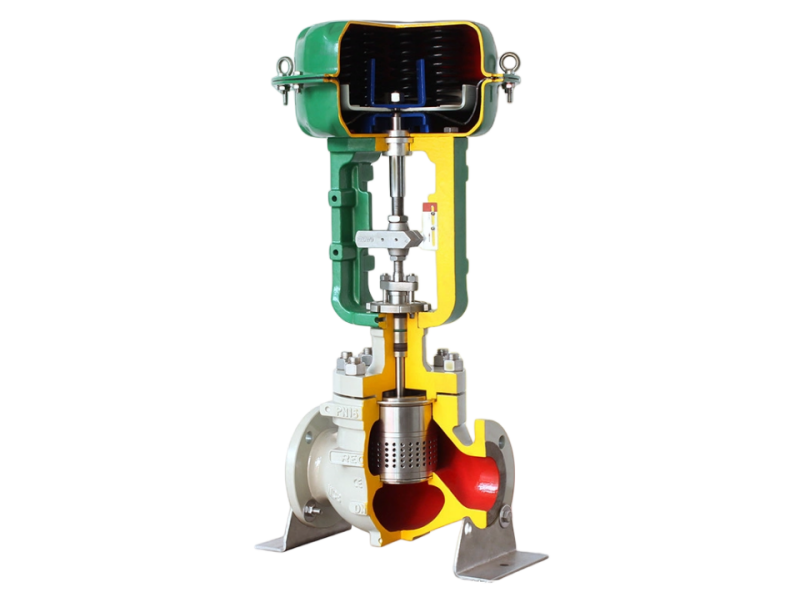
The flow coefficient, written Kv or Cv, is the standard measure of how much fluid a control valve can pass at its rated travel under defined conditions. It drives valve sizing, rangeability and the match between valve and process, so it is where valve selection starts.
Kv and Cv Defined
Kv is the flow rate, in cubic meters per hour, of water at 20 °C through the valve at rated travel with a pressure drop of 1 bar. Cv is the same idea in imperial units: US gallons per minute of water at 60 °F with a pressure drop of 1 psi. The two describe the same physical capacity in different unit systems, and the conversion is Cv ≈ 1.156 × Kv (equivalently, Kv ≈ Cv / 1.156).
Why Kv Matters
Getting the rated Kv right matters in three places. Sizing: an undersized valve cannot deliver the maximum flow, and an oversized one spends its life at small openings, controlling poorly and eroding the trim. Rangeability: the ratio of maximum to minimum controllable flow, typically 30:1 or 50:1 for NW VALVE control valves, is defined at the rated Kv. Actuator sizing: the forces on the plug, which decide the required actuator thrust, are calculated at the rated differential pressure.
Sizing Basics: The Liquid Formula
For liquid service, the required coefficient comes from the maximum flow and the allowable pressure drop:
Cv = Q × √(Gf / ΔP)
- Q: maximum flow rate in US gpm
- Gf: specific gravity of the liquid (water = 1)
- ΔP: allowable pressure drop across the valve in psi
The same formula works in metric units for Kv, with Q in m³/h and ΔP in bar. Gases and steam are another matter: the compressibility factor, the inlet pressure and the critical pressure ratio all come into play, so use a manufacturer sizing calculation rather than the liquid formula.
Step-by-Step Sizing Example
- Define the duty: water at 20 °C, maximum flow 40 m³/h, allowable pressure drop 100 kPa (1 bar). Specific gravity is 1.
- Calculate the required Kv: Kv = Q × √(Gf / ΔP) = 40 × √(1 / 1) = 40.
- Apply a margin: choose a valve with a rated Kv of at least 40 × 1.3 ≈ 52, so the valve operates in its best control range at maximum flow.
- Select the size: compare with the valve Kv table and pick the size with a rated Kv closest above 52.
- Verify: check that the minimum flow stays inside the controllable range (rangeability check), and that pressure drop and noise are acceptable.
Kv Values of Common Valve Sizes
The table below shows typical full-stroke flow coefficients for common valve sizes, for reference:
| Nominal Diameter | Full-Stroke Cv (Equal Percentage) | Full-Stroke Cv (Linear) | Equivalent Kv (Equal Percentage) |
|---|---|---|---|
| DN15 | 4.0 | 3.8 | ≈ 3.5 |
| DN25 | 11 | 10 | ≈ 9.5 |
| DN50 | 44 | 42 | ≈ 38 |
| DN100 | 160 | 150 | ≈ 138 |
Values are typical examples; the exact rated Kv of each size and model should be taken from the manufacturer’s Kv table.
Conclusion
Kv and Cv quantify what a control valve can pass and are the basis of sizing. The procedure, maximum flow, allowable pressure drop, a sizing margin and a rangeability check, keeps the valve working in its best control range. For liquids the simple formula is enough; for gases and steam, use the manufacturer’s calculation.

 No products in the cart.