
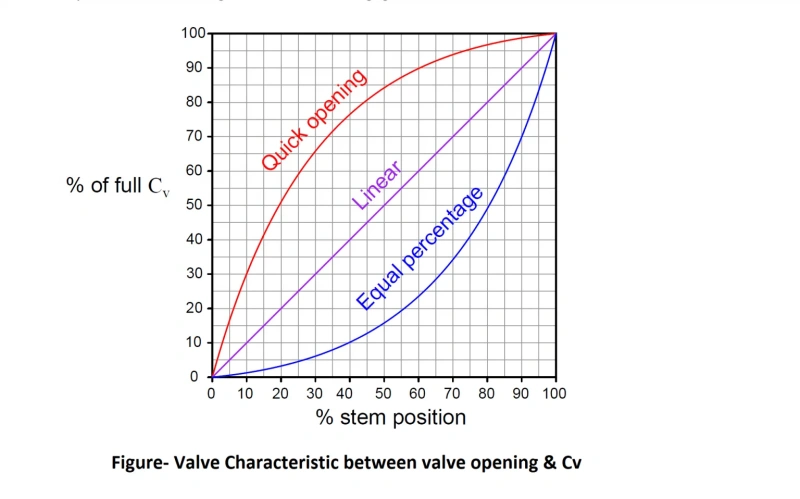
The flow characteristic of a control valve is the relationship between the valve travel (how far the plug opens) and the flow rate through the valve. It is one of the first things you set when selecting a valve, because it decides how the valve responds to the control signal and, in practice, how well the whole loop controls. There are three standard curves: linear, equal percentage and quick-opening.
Linear Characteristic
With a linear characteristic, flow is directly proportional to travel: a 10 % increase in travel gives a 10 % increase in flow. The valve gain, the ratio of flow change to travel change, stays constant across the whole opening range. That makes it the right choice when the pressure drop across the valve is roughly constant regardless of opening, as in some level and flow control loops. The constant valve gain then matches the process, and the loop behaves predictably.
Equal Percentage Characteristic
An equal percentage characteristic gives equal percentage changes in the existing flow for equal increments of travel. Each step of travel multiplies the current flow by the same factor. The gain is low near the closed position, which gives precise, stable throttling on small openings, and rises as the valve opens, so the response is there when you need it. That shape fits varying pressure drop systems, the common case in real plants, because the low gain near the seat compensates for the high system gain in that region and the loop ends up more linear overall. It is also the natural choice when a wide regulation range is needed. For these reasons equal percentage is the standard pick for most throttling duties. NW VALVE control valves are typically supplied with linear and equal percentage characteristics, with rangeability up to 30:1 or 50:1 depending on the model.
Quick-Opening Characteristic
A quick-opening characteristic produces a large flow increase for a small movement of the plug away from the seat, and the valve reaches nearly full capacity within a short portion of its travel. The gain is very high near the seat and falls off quickly as the valve opens. That is exactly what on-off and emergency shut-off service needs: open fully with minimal travel, close tightly when required. It is also used where a small proportional adjustment is needed only near the closed position. Shut-off ball valves are the typical example.
How to Choose the Right Characteristic
Matching the characteristic to the system is the whole job here:
- Constant pressure drop across the valve (some level and flow loops): choose the linear characteristic.
- Varying pressure drop, wide regulation range, or general throttling: choose equal percentage. This is the safest default for most applications.
- On-off, quick shut-off or safety functions: choose quick-opening.
| Characteristic | Definition | Gain Behavior | Typical Application |
|---|---|---|---|
| Linear | Flow proportional to travel (10 % travel → 10 % flow) | Constant gain across the travel | Constant pressure drop systems; level and flow loops |
| Equal percentage | Equal travel increments give equal percentage flow changes | Low gain at small openings, high gain at large openings | Varying pressure drop systems; wide range throttling (recommended default) |
| Quick-opening | Near-full flow reached within a short travel | Very high gain near the seat | On-off and emergency shut-off service |
Conclusion
The characteristic has to match the pressure drop behavior of the system, the regulation range and the control objective. When in doubt, equal percentage is the safest choice for throttling control, quick-opening is for on-off duties, and linear is for constant pressure drop systems. Getting this one right is one of the simplest ways to make a loop control well.

 No products in the cart.