
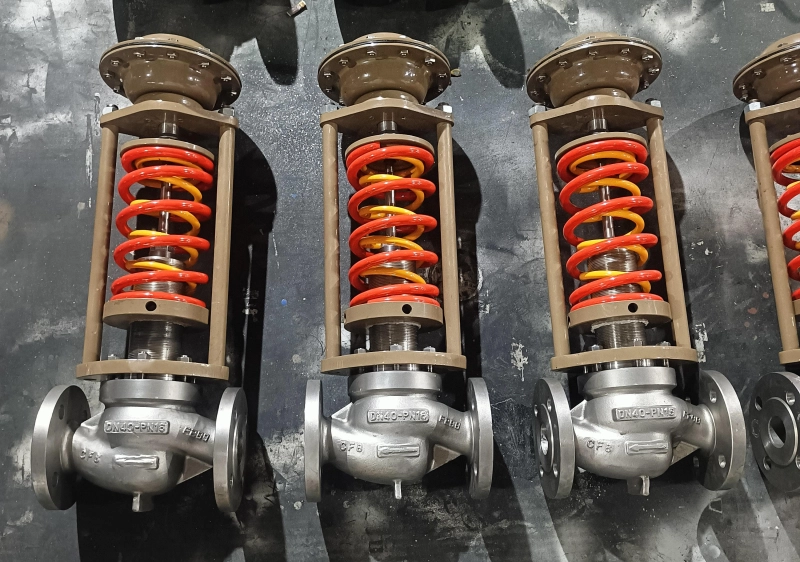
Positioning of Self-Operated Pressure Regulators in Process Control
A self-operated pressure regulator is a control valve that requires no external air or power supply, relying only on the pressure of the process medium itself to stabilize or limit pressure.
Essential difference from externally powered control valves
| Comparison Dimension | Self-Operated Pressure Regulator | Electric / Pneumatic Control Valve |
|---|---|---|
| Driving energy | No external energy; driven by media pressure | Requires instrument air (pneumatic) or electricity (electric) |
| Control accuracy | ±5-10 % (direct-acting) / ±2-5 % (pilot-operated) | ±0.1 % (with smart positioner) |
| Response characteristics | Slow; responds naturally to pressure fluctuations | Fast (seconds to tens of seconds); response curve can be preset |
| Fail-safe | Inherently safe (no external energy dependency) | Requires a fail position strategy on power or air loss |
| System complexity | Very low; single mechanical assembly, no electronic components | High; actuator + positioner + control system + accessories |
| Initial investment | Low | Medium to high |
| Maintenance cost | Extremely low; almost maintenance-free mechanical construction | Periodic positioner calibration, filter element replacement, etc. |
| Applicable control strategy | Single-parameter (pressure) setpoint control | Multi-parameter compound control (pressure + flow + temperature + interlock) |
Core positioning: when accuracy requirements are modest but reliability and maintenance-free operation are the priorities, the self-operated solution is the optimal choice.
Working Principle and Classification
Direct-acting vs pilot-operated
| Type | Working Principle | Control Accuracy | Applicable Differential Pressure | Typical Size |
|---|---|---|---|---|
| Direct-acting | Media pressure acts directly on the diaphragm/spring; spring force balances the pressure | ±5-10 % | Moderate | DN15-DN100 |
| Pilot-operated | The pilot senses pressure changes and controls exhaust/admission to the main valve diaphragm chamber, driving the main valve indirectly | ±2-5 % | Large differential pressure | DN25-DN400 |
The direct-acting type is simpler in construction, more reliable and lower in cost; the pilot-operated type offers higher accuracy, larger sizes and a wider applicable differential pressure range.
Classification by control function
| Function Type | Control Objective | Installation Position | Typical Application |
|---|---|---|---|
| Pressure reducing valve | Maintains downstream (outlet) pressure stable | Pipeline pressure reduction point | Gas pressure regulation; steam heating pressure/temperature reduction |
| Pressure relief / back pressure valve | Keeps upstream (inlet) pressure from exceeding the setpoint | Pressure protection point | Pipeline overpressure protection; compressor outlet relief |
| Differential pressure control valve | Holds a constant differential pressure across the valve | Duty requiring constant DP | Filtration systems; flow measurement |
Typical Application Scenarios
Gas regulation station
| Parameter | Typical Value |
|---|---|
| Media | Natural gas, town gas, vaporized LNG |
| Inlet pressure | 0.4-4.0 MPa |
| Outlet pressure | 2-50 kPa or 0.1-0.4 MPa (per downstream demand) |
| Accuracy requirement | ±5-10 % |
Recommended solution: pilot-operated self-operated pressure reducing valve (two-stage regulation is more reliable).
Gas regulation stations are usually located far from the plant area with no instrument air or power available, making the self-operated reducing valve the industry-standard choice.
Steam heating system
| Parameter | Typical Value |
|---|---|
| Media | Saturated / superheated steam |
| Inlet pressure | 0.5-2.5 MPa |
| Outlet pressure | 0.1-0.6 MPa |
| Accuracy requirement | ±5-10 % (heating) / ±2-5 % (process) |
Recommended solution: direct-acting or pilot-operated self-operated reducing valve.
Steam users in a heating system are usually scattered across different workshops, and equipping each branch with a self-operated reducing valve is the most economical pressure stabilization scheme. In critical processes (such as pharmaceutical clean steam or chemical reactor temperature control) that demand higher accuracy (±0.1 %) and faster response, electric cage or single-seat control valves with smart positioners can be used for closed-loop control.
Oil pipeline pressure protection
| Parameter | Typical Value |
|---|---|
| Media | Crude oil, refined products, liquid hydrocarbons |
| Set pressure | 1.05-1.1 × pipeline design pressure |
| Action requirement | Relief valve opens quickly to prevent overpressure |
Recommended solution: self-operated relief/back pressure valve (spring-loaded direct-acting).
Overpressure protection of oil pipelines demands extremely high reliability. Automated control valve trains require pressure transmitters and a safety PLC interlock, a complex system with the risk of electronic component failure. As a purely mechanical protection device independent of external power and control systems, the self-operated relief valve is the last line of defense against pipeline overpressure.
Chemical tank nitrogen blanketing
| Parameter | Typical Value |
|---|---|
| Media | Nitrogen |
| Set pressure | Slight positive pressure 0.5-2 kPa |
| Accuracy requirement | ±5 % (low-pressure micro-pressure control) |
Recommended solution: direct-acting self-operated micro-pressure regulator.
Tank blanketing must maintain a stable slight positive pressure inside the tank to prevent air ingress (which could form an explosive mixture) or to protect the product from oxidation. The self-operated micro-pressure regulator has simple construction and direct response, needs no power, and is the most widely adopted standard configuration.
Other application scenarios
| Scenario | Recommended Self-Operated Solution |
|---|---|
| Gas manifold pressure stabilization | Direct-acting reducing valve |
| Compressed air station post-treatment | Pilot-operated reducing valve |
| Chemical pump mechanical seal flush | Differential pressure control valve |
| Reactor back pressure control | Pilot-operated relief valve |
| HVAC steam/hot water distribution | Direct-acting reducing valve |
Selection Boundaries of Self-Operated Regulators
Self-operated pressure regulators are not applicable, or require careful evaluation, in the following scenarios:
| Non-Applicable Scenario | Reason | Recommended Alternative |
|---|---|---|
| Remote monitoring and setpoint adjustment required | Self-operated setpoint requires manual spring compression adjustment on site | Electric control valve with smart positioner |
| Control accuracy ≤ ±1 % required | Inherent accuracy limit of self-operated types (max ±2 % for pilot-operated) | Electric control valve (±0.1 %) |
| Frequently changing setpoints | Spring adjustment requires process shutdown | Pneumatic/electric control valve with positioner |
| Temperature control (steam temperature must vary with pressure) | Self-operated valve controls pressure only, not temperature directly | Electric control valve + temperature transmitter + PLC closed loop |
| Fast response requirement (sub-second) | Self-operated response varies naturally with media pressure fluctuations | Pneumatic control valve (second-level response) |
| Media with heavy particulate content | Particles may clog pilot channels | Pilot type with strainer, or electric control valve |
Selection Process for Self-Operated Pressure Regulators
- Confirm the control objective: reducing (downstream stabilization) / relief (upstream limiting) / differential pressure.
- Determine the process parameters: media, inlet pressure range, outlet set pressure, maximum/normal/minimum flow.
- Select the action type: direct-acting (small size, small differential pressure) vs pilot-operated (large size, large differential pressure, higher accuracy).
- Calculate the size: compute the required Cv value from flow and differential pressure, and match the corresponding size.
- Confirm materials: select the body material by media corrosivity (carbon steel / stainless steel / special alloys) and the diaphragm material by media compatibility.
- Accessories: sensing line, strainer and shut-off valve (if required).
- Accuracy vs cost trade-off: ±5-10 % self-operated vs ±0.1 % electric/pneumatic control valve solutions.
 No products in the cart.